How to Stop Procrastinating with Time Blocking (Complete Guide)
Overcome procrastination using time blocking. Science-backed strategies and the best tools to actually get things done.
Open Sunsama Team · · Updated · 14 min read
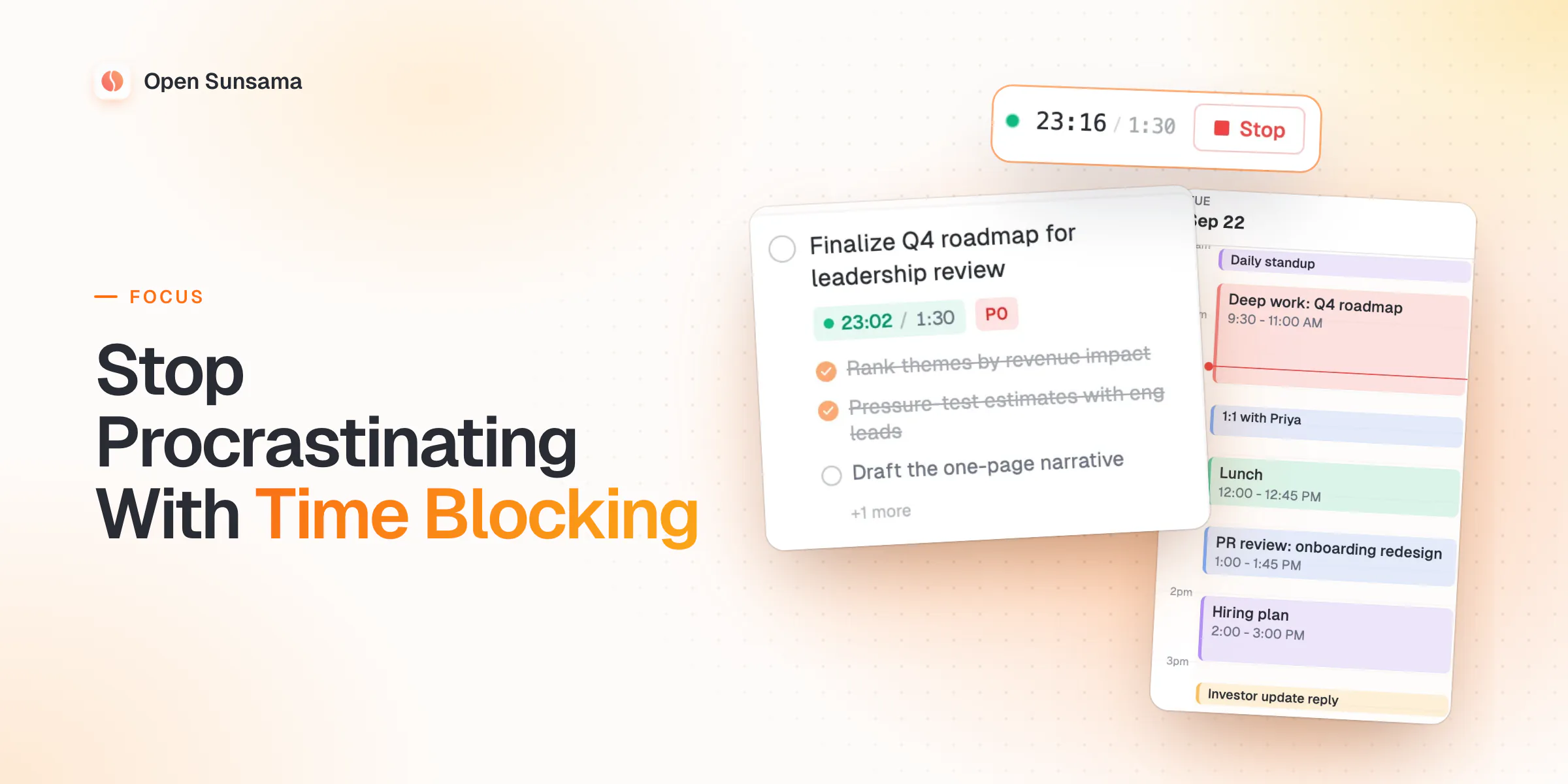
You know the feeling. That important project sits in your task list, deadline creeping closer, while you somehow find yourself reorganizing your desk, scrolling through emails you've already read, or falling into a YouTube rabbit hole about topics you'll never think about again.
Procrastination isn't a character flaw—it's a human condition that affects an estimated 20% of adults chronically and virtually everyone occasionally. The good news? Understanding why we procrastinate reveals exactly how to stop it. And the most effective weapon against procrastination isn't willpower or motivation—it's time blocking.
This guide will show you the psychology behind procrastination, why time blocking specifically counteracts it, and give you a step-by-step system to finally overcome procrastination and get things done. If you're new to time blocking, start with our guide on what time blocking is first.
Why We Procrastinate: The Psychology Behind Avoidance
Before learning how to stop procrastinating, we need to understand why it happens. Contrary to popular belief, procrastination isn't about laziness or poor time management. It's about emotion regulation.
Procrastination Is an Emotional Problem
Dr. Tim Pychyl, a leading procrastination researcher at Carleton University, explains that procrastination is "the primacy of short-term mood repair over the longer-term pursuit of intended actions." In plain language: we procrastinate to feel better right now, even when it hurts us later.
When faced with a difficult, boring, or anxiety-inducing task, our brains instinctively seek relief. That relief comes from avoidance—doing something easier, more pleasant, or less threatening instead. The task doesn't go away, but our immediate discomfort does.
The Brain Science of Avoidance
Neuroscience research reveals that two brain regions battle during procrastination:
- The limbic system (your emotional brain): Responds to immediate threats and rewards, favors short-term pleasure, and triggers avoidance of discomfort
- The prefrontal cortex (your rational brain): Handles planning, long-term thinking, and self-regulation
When a task triggers negative emotions—fear of failure, boredom, overwhelm—your limbic system often wins the battle, pulling you toward immediate comfort instead of meaningful work.
Common Procrastination Triggers
Understanding your personal triggers helps you beat procrastination. Most procrastination stems from one of these emotional responses:
| Trigger | What It Feels Like | Example |
|---|---|---|
| Fear of failure | Anxiety about not being good enough | Delaying the presentation because it might not impress |
| Perfectionism | Paralysis until conditions are "right" | Waiting for the perfect moment to start writing |
| Overwhelm | Feeling the task is too big to tackle | Avoiding the project because you don't know where to begin |
| Boredom | Lack of stimulation or interest | Putting off data entry for anything more engaging |
| Resentment | Resistance to tasks imposed by others | Delaying the report your manager requested |
| Decision fatigue | Too many choices about what to do | Staring at your task list without starting anything |
Recognizing which trigger is operating helps you choose the right countermeasure.
Why Time Blocking Beats Willpower for Overcoming Procrastination
If procrastination is an emotional regulation problem, why do most "solutions" focus on motivation, discipline, or shame? Those approaches rarely work because they fight against your brain's natural tendencies.
Time blocking works because it doesn't require you to feel motivated. Instead, it creates external structures that guide behavior regardless of how you feel.
The Willpower Myth
Research by psychologist Roy Baumeister demonstrated that willpower operates like a muscle—it fatigues with use. Every time you resist a temptation or force yourself to do something unpleasant, you deplete a limited resource. By mid-afternoon, your willpower reserves are often exhausted, making procrastination almost inevitable.
Time blocking bypasses willpower dependency. When 9:00 AM arrives and your calendar shows "Work on quarterly report," the question isn't "Do I feel like doing this?" It's simply "What does my schedule say I'm doing right now?"
How Time Blocking Defuses Procrastination Triggers
Time blocking directly addresses each major procrastination trigger:
| Procrastination Trigger | How Time Blocking Helps |
|---|---|
| Fear of failure | Smaller blocks make the task less threatening; you're not committing to finishing, just to 45 minutes of work |
| Perfectionism | Time limits force you to make progress rather than waiting for perfect conditions |
| Overwhelm | Breaking large projects into scheduled blocks makes them manageable |
| Boredom | Knowing the block ends soon makes tedious tasks more bearable |
| Resentment | You chose when to do the task, preserving autonomy |
| Decision fatigue | Your schedule already decided what you'll work on |
The Commitment Device Effect
Behavioral economists call it a "commitment device"—a choice made in advance that restricts future options. Ulysses tied himself to the mast to resist the Sirens. Time blocking is your mast.
When you schedule a task for 2:00 PM tomorrow, you're making a commitment when you're calm and rational. When 2:00 PM arrives and your emotional brain wants to avoid the task, the commitment is already made. The barrier to breaking your own commitment is higher than the barrier to procrastinating on an unbounded task list.
The Science Behind Time Blocking for Procrastination
Time blocking isn't just a productivity hack—it's grounded in decades of behavioral research.
Implementation Intentions Double Follow-Through
Psychologist Peter Gollwitzer's research on "implementation intentions" shows that specifying when and where you'll do something dramatically increases the likelihood of follow-through. In studies, people who stated "I will exercise at 7:00 AM in my living room" were 2-3x more likely to actually exercise than those who simply intended to exercise.
Time blocking is implementation intentions applied to your entire day. Every task has a when and where, transforming vague intentions into concrete plans.
Parkinson's Law Works in Your Favor
Parkinson's Law states that work expands to fill the time available. Without a boundary, that report could take all day—or all week. But when you've blocked exactly 90 minutes, you'll naturally compress the work to fit.
This isn't about rushing. It's about the focus that emerges when you know time is finite. Studies show that people working under time constraints often produce work of equal or better quality, faster.
The Zeigarnik Effect Creates Motivation
Psychologist Bluma Zeigarnik discovered that uncompleted tasks create mental tension that persists until the task is finished. This is why that unfinished project keeps nagging at you.
Time blocking leverages this effect by making "start the task" the immediate goal rather than "finish the task." Once you begin during your scheduled block, the Zeigarnik effect kicks in—your brain wants to complete what it started. The hardest part of overcoming procrastination is starting, and time blocking makes starting the only required commitment.
Reduce Context Switching, Increase Flow
Gloria Mark's research at UC Irvine found that knowledge workers switch tasks every 3 minutes on average, and each switch costs 23+ minutes of refocusing time. Procrastination thrives in this fragmented environment—there's always something easier to switch to.
Time blocking creates protected periods for single-task focus. Within your block, there's no decision to make about what to do next. This constraint paradoxically creates freedom—the freedom to enter a flow state where work feels effortless. Cal Newport calls this state "deep work"—and it's where your best output happens.
How to Stop Procrastinating: A Step-by-Step Time Blocking System
Ready to beat procrastination for good? Follow this proven five-step system.
Step 1: Identify Your Procrastination Triggers
Before you can stop procrastinating, you need to understand when and why it happens. For one week, track every instance of procrastination:
- What task were you avoiding?
- What did you do instead?
- What emotion were you feeling? (Anxiety, boredom, overwhelm, etc.)
- What time of day was it?
- What preceded the procrastination? (A particular email, meeting, etc.)
This data reveals your patterns. You might discover:
- You always procrastinate on financial tasks (fear-based)
- You delay creative work after meetings (energy depletion)
- You avoid tasks from specific people (resentment)
- You procrastinate most at 2-4 PM (energy dip)
With this awareness, you can design a time-blocking system that accounts for your specific vulnerabilities.
Step 2: Break Tasks into Small, Scheduled Blocks
Large, ambiguous tasks are procrastination magnets. "Work on thesis" is terrifying. "Write 500 words of Chapter 3 introduction" is manageable.
Apply these principles when breaking down tasks:
The 45-minute rule: Most people can focus on even unpleasant tasks for 45 minutes. If a task feels overwhelming, ask: "Can I do this for just 45 minutes?" Schedule a 45-minute block.
Specify the action: Replace vague tasks with specific actions:
- "Work on presentation" → "Draft slides 1-5 of Q1 presentation"
- "Handle emails" → "Process inbox to zero, respond to flagged items"
- "Exercise" → "30-minute run on the treadmill"
Estimate conservatively: Tasks typically take 50% longer than expected. If you think something will take an hour, block 90 minutes. Under-promise to yourself; over-deliver.
Step 3: Schedule Specific Times for High-Procrastination Tasks
The tasks you procrastinate most need the most protection. Schedule them during:
Your peak energy hours: For most people, this is 2-4 hours after waking. If you're sharpest at 9 AM, that's when your hardest, most-avoided task should happen—before your willpower depletes.
Before triggering activities: If you always procrastinate after checking email, schedule deep work before email review. Don't give yourself the option to fall into avoidance patterns.
With adequate buffer: Don't schedule a dreaded task right before a meeting. You'll watch the clock instead of working. Give yourself space to focus without time pressure.
A sample anti-procrastination schedule:
7:30 AM - 8:00 AM    Morning routine (no devices)
8:00 AM - 9:30 AM    [HIGH-PROCRASTINATION TASK] - Protected deep work
9:30 AM - 9:45 AM    Break + movement
9:45 AM - 10:30 AM   Email and communication
10:30 AM - 12:00 PM  Secondary projects
12:00 PM - 1:00 PM   Lunch (away from desk)
1:00 PM - 2:30 PM    Meetings and collaboration
2:30 PM - 3:00 PM    Administrative tasks
3:00 PM - 4:00 PM    Second deep work block
4:00 PM - 4:30 PM    Daily review and tomorrow's planning
Step 4: Use Commitment Devices to Enforce Your Blocks
Time blocking creates commitments, but commitments are only as strong as their enforcement. Add friction to breaking them:
Public accountability: Tell a colleague "I'm working on the proposal from 9-11 AM." Knowing someone else knows creates social pressure to follow through.
Environment design: When your focus block starts, close unnecessary tabs, put your phone in another room, and use website blockers. Make procrastination harder than working.
Calendar visibility: Block time in your shared calendar so others don't schedule over it. Treat focus blocks like important meetings you can't skip.
Use focus mode tools: Apps like Open Sunsama offer focus mode features that hide your task list and display only the current task with a timer. When you can only see one thing, distraction requires extra effort.
The two-minute start: When your block begins, commit only to two minutes of work. Open the document, write one sentence, make one sketch. Starting is the hardest part—momentum usually takes over.
Step 5: Build Momentum with Easy Wins
Strategic task ordering can prevent procrastination before it starts:
Start your day with completion: Begin with a 15-30 minute task you can definitely finish. The dopamine hit from early completion builds momentum for harder work.
Alternate difficulty: After a challenging block, schedule something easier. After easy work, tackle something harder. This rhythm prevents both burnout and boredom.
End on a cliffhanger: Stop mid-task when you know exactly what comes next. Tomorrow, you'll start with momentum rather than facing the "blank page" problem.
Celebrate block completion: Acknowledge when you honor your time blocks. This positive reinforcement strengthens the habit over time.
Tools for Time Blocking to Beat Procrastination
The right tools make time blocking easier to implement and harder to abandon.
Why Open Sunsama Is Built for Fighting Procrastination
Open Sunsama is specifically designed for daily planning and time blocking—exactly what you need to overcome procrastination:
Drag-and-drop scheduling: See your task list next to your calendar. Drag any task onto a time slot to create a block. No copying, no manual entry—just instant commitment.
Visual daily planning: The side-by-side view shows what you need to do and when you'll do it. This clarity eliminates the "what should I work on?" paralysis that enables procrastination.
Focus mode: When it's time to work, Open Sunsama's focus mode displays only your current task with an optional timer. Everything else disappears. Your procrastination triggers—the other tasks, the notifications, the overwhelm—are hidden.
Smart time tracking: Over time, Open Sunsama learns how long tasks actually take. Better estimates mean more realistic blocks, which means fewer missed commitments.
Open source and AI native: The code is public, and any AI agent (Claude, ChatGPT or any MCP client) can plan your day and break a stuck task into steps.
Command palette (Cmd+K): Quickly create tasks and blocks without leaving your keyboard. The faster you can capture and schedule, the less chance for procrastination to creep in.
How to Use Open Sunsama for Anti-Procrastination Time Blocking
-
Morning planning (5-10 minutes): Open your daily view. Review yesterday's incomplete tasks. Drag your highest-procrastination task to your peak energy slot. Fill the rest of your day with blocks.
-
Execution: When a block starts, click into focus mode. Set a timer if helpful. Work only on that task until the block ends or the task completes.
-
Evening review (2-3 minutes): Check which blocks you honored. Reschedule incomplete tasks. Celebrate wins.
Other Time Blocking Tools
| Tool | Strength | Best For | Cost |
|---|---|---|---|
| Open Sunsama | Purpose-built daily planning with focus mode | People serious about beating procrastination | Open source |
| Google Calendar | Ubiquity and simplicity | Basic time blocking | Free |
| Notion Calendar | Database integration | Notion users | Free |
| Reclaim.ai | AI-powered scheduling | Automated block placement | Freemium |
| Sunsama | Ritual-based workflow | Teams with budget | $20/month |
| Akiflow | Universal inbox | Power users | $24/month |
Common Mistakes That Cause Procrastination to Return
Even with time blocking, certain mistakes can sabotage your progress.
Mistake #1: Scheduling Without Buffer
The problem: Back-to-back blocks with no breathing room. When one task runs over (they often do), your entire schedule collapses, triggering overwhelm and avoidance.
The fix: Leave 15-minute buffers between major blocks. Schedule only 60-70% of your day. The remaining time absorbs overflow and unexpected demands.
Mistake #2: Tackling Hard Tasks at Low-Energy Times
The problem: Scheduling your most-avoided task at 3 PM when you're exhausted. You'll skip it every time.
The fix: Reserve your first 2-4 hours for high-procrastination tasks. Use low-energy periods for routine work that doesn't trigger avoidance.
Mistake #3: Making Blocks Too Long
The problem: A 4-hour block feels endless when you're fighting procrastination. The prospect of such a long commitment triggers avoidance before you even start.
The fix: For tasks you typically procrastinate, keep blocks at 45-90 minutes maximum. You can schedule multiple blocks, but each individual commitment should feel manageable.
Mistake #4: All-or-Nothing Thinking
The problem: You miss one block, feel like a failure, and abandon the entire system.
The fix: Expect imperfection. A 60% adherence rate is infinitely better than no system at all. When you miss a block, simply reschedule and move on. The goal is progress, not perfection.
Mistake #5: Never Reviewing
The problem: You keep scheduling the same unrealistic blocks, keep failing, and lose trust in your own commitments.
The fix: End each day with a 2-minute review. Which blocks worked? Which didn't? Why? Adjust tomorrow's schedule based on real data, not wishful thinking.
Mistake #6: Blocking Work but Not Recovery
The problem: You fill every slot with tasks, then wonder why you burn out and revert to procrastination.
The fix: Block time for lunch, breaks, and personal activities. Rest is not optional—it's the fuel that makes focused work possible.
Building Anti-Procrastination Habits That Last
Time blocking works immediately, but lasting change requires habit formation.
The First Two Weeks: Establish the Routine
Your only goal during the first two weeks is to build the habit of time blocking itself:
- Plan tomorrow's blocks every evening (5 minutes)
- Review today's blocks every evening (2 minutes)
- Start each day by checking your first block (30 seconds)
Don't worry about perfect adherence yet. Just do the planning and reviewing consistently.
Weeks 3-6: Calibrate and Optimize
Now refine your system:
- Adjust block lengths based on what actually works
- Identify persistent procrastination patterns and address root causes
- Experiment with different scheduling strategies
- Build in rewards for consistent adherence
By week 6, you should have a personalized system that accounts for your energy patterns, procrastination triggers, and realistic task durations.
Beyond Week 6: Maintain and Evolve
Time blocking becomes automatic with practice. Maintain the habit by:
- Weekly reviews: Assess overall patterns, not just daily performance
- Monthly experiments: Try new approaches to keep the system fresh
- Forgiving slip-ups: Missed days happen. The system works if you keep returning to it
- Celebrating progress: Compare your productivity now to before you started
Frequently Asked Questions
What is the best way to stop procrastinating?
The most effective way to stop procrastinating is to use time blocking—scheduling specific tasks for specific times in your calendar. This works because procrastination is an emotional regulation problem, not a time management problem. Time blocking creates external structure that guides behavior regardless of how you feel, bypassing the need for willpower or motivation.
Does time blocking really work for procrastination?
Yes. Time blocking directly addresses the psychological roots of procrastination. Research on "implementation intentions" shows that specifying when and where you'll do something makes you 2-3x more likely to follow through. Time blocking applies this principle to your entire day, transforming vague intentions into concrete commitments that are harder to break.
How do I stop procrastinating when I feel overwhelmed?
Break the overwhelming task into small, specific blocks of 45 minutes or less. Instead of "write the report," schedule "write the introduction (45 min)." When a task feels too big, your brain triggers avoidance. Smaller blocks feel manageable, making it easier to start. Once you start, momentum typically carries you forward.
Why do I procrastinate even when I know the consequences?
Procrastination is driven by your emotional brain (limbic system), which prioritizes immediate comfort over future benefits. Your rational brain knows the consequences, but your emotional brain doesn't care about tomorrow—it wants relief now. Time blocking works because it creates commitments when you're calm and rational that constrain your behavior when emotions push toward avoidance.
What is the best app to stop procrastinating?
Open Sunsama is the best app for beating procrastination through time blocking. It combines a task list with calendar scheduling, letting you drag tasks directly onto your schedule. The focus mode hides distractions and shows only your current task, making it easier to concentrate. It is open source, and any AI agent can run it through MCP.
How long should time blocks be for someone who procrastinates?
For tasks you frequently avoid, start with 45-minute blocks. This duration is long enough to make meaningful progress but short enough to feel manageable. If 45 minutes still feels daunting, try 25-minute blocks using the Pomodoro Technique. Once you build confidence and momentum, you can experiment with longer 60-90 minute blocks.
Can I use time blocking if I have ADHD?
Time blocking can be very effective for ADHD, with some modifications. Use shorter blocks (25-45 minutes), build in movement breaks, and include buffer time for hyperfocus or transition struggles. The external structure of time blocking can be especially helpful when internal regulation is challenging. Tools like Open Sunsama's focus mode can reduce the distraction that often triggers procrastination.
What should I do when I procrastinate despite having a schedule?
When you procrastinate despite a schedule, it usually indicates one of three issues: (1) The block is too long or the task too vague—make it smaller and more specific. (2) You're scheduling at the wrong time—move high-procrastination tasks to peak energy hours. (3) You need more commitment devices—tell someone about your block, use website blockers, or try body-doubling. Don't shame yourself; adjust and try again.
How do I overcome procrastination in the afternoon when my energy is low?
Avoid scheduling high-procrastination tasks during your natural energy dip (typically 2-4 PM for most people). Instead, use this time for routine tasks that don't require deep focus—email, administrative work, or low-stakes meetings. Save tasks you tend to avoid for your peak hours, usually morning. If you must tackle something difficult in the afternoon, keep the block short and use your focus mode tool.
How long does it take to stop procrastinating with time blocking?
You'll likely notice improvements within the first week of consistent time blocking. However, building a sustainable anti-procrastination system typically takes 4-6 weeks of practice and refinement. During this time, you'll learn your optimal block lengths, identify persistent triggers, and develop realistic time estimates. Be patient with yourself—habit formation takes time.
Conclusion: Stop Procrastinating Starting Today
Procrastination isn't a character flaw you're stuck with. It's a predictable emotional response with well-understood triggers—and time blocking directly counteracts every one of them.
You don't need more motivation. You don't need to wait until you "feel like it." You need a system that guides your behavior regardless of how you feel. Time blocking is that system.
Here's your next step: Start with one high-procrastination task. The project you've been avoiding, the email you don't want to write, the work that triggers anxiety. Schedule a 45-minute block for it tomorrow morning, during your peak energy hours.
When that block arrives, you only need to start. Give it two minutes. The Zeigarnik effect will take over—your brain wants to finish what it starts. That's how you beat procrastination: not through willpower, but through well-designed commitments.
Ready to build your anti-procrastination system? Open Sunsama is a time blocking app that makes time blocking effortless with drag-and-drop scheduling, focus mode, and the visual clarity you need to see your plan and stick to it.
Create your account and stop procrastinating—starting now.
This guide is part of Open Sunsama's productivity resource library. For more on time blocking, read our complete guide to time blocking or learn how to create an effective daily schedule.