How to Set Daily Goals That You'll Actually Achieve
Learn to set effective daily goals with proven frameworks. Examples, templates, and the best tools for daily planning.
Open Sunsama Team · · Updated · 11 min read
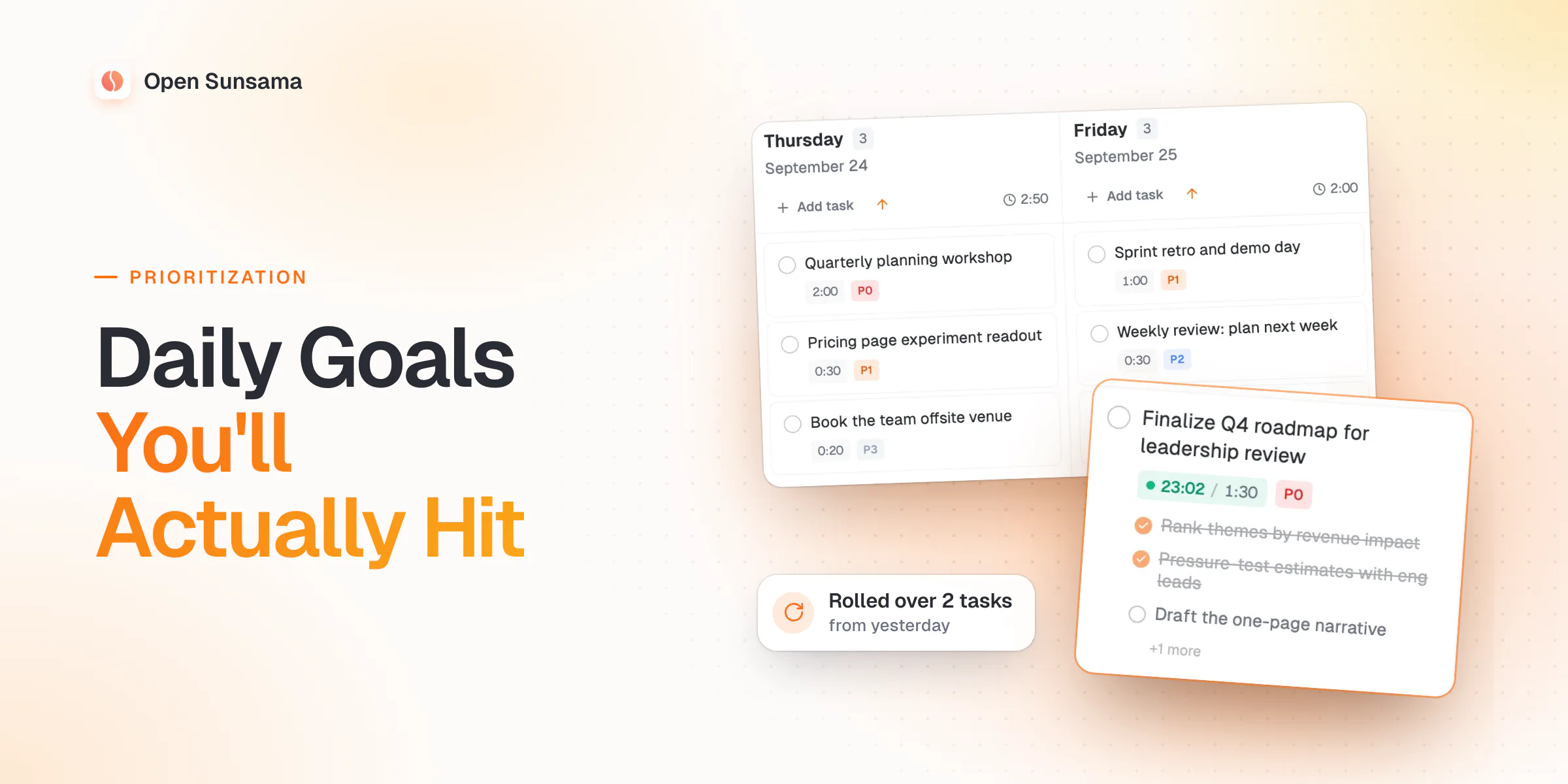
You've probably tried setting daily goals before. "Today I'll finish the report, respond to all emails, exercise, call mom, and finally organize my desk." By noon, half those goals feel impossible. By 5 PM, you've abandoned them entirely. Sound familiar?
The problem isn't your willpower or discipline. It's that most advice on how to set daily goals misses the science of what makes goals actually achievable. Research from the American Psychological Association shows that specific, challenging goals lead to higher performance 90% of the time—but only when structured correctly.
This guide will teach you effective daily goal setting using frameworks that psychologists, productivity researchers, and high performers actually use. You'll learn why your current approach isn't working, discover four proven daily goal frameworks, and walk away with a step-by-step process you can start tonight. For broader context, see our complete daily planning guide.
Why Most Daily Goals Fail
Before learning how to set daily goals that work, you need to understand why most don't. The failure patterns are predictable—and avoidable.
Too Many Goals
The most common daily goal setting mistake is quantity over quality. Your brain has limited executive function. When you set 10 goals, you're essentially telling your brain that nothing is truly important—so it treats everything as optional.
Research by psychologist Dr. Roy Baumeister demonstrates that willpower depletes throughout the day. Each decision, each goal you actively pursue, draws from the same limited pool. Ten goals means ten simultaneous draws on that pool.
The solution isn't trying harder. It's setting fewer, better goals.
Vague Goals
"Be more productive" isn't a goal. Neither is "work on the project" or "eat healthier." These are directions, not destinations. Your brain doesn't know when you've achieved a direction.
Effective daily goals have a clear finish line. You know the moment you cross it. Without that clarity, your brain can't generate the dopamine reward of completion—which means it loses motivation to continue.
No Connection to Time
A goal without a time allocation is a wish. "Finish the presentation" lives in a fantasy world where time is infinite and nothing else competes for your attention.
When you set daily goals without connecting them to your actual available time, you're planning for a day that doesn't exist. This disconnect between your goals and reality guarantees failure before you start.
Outcome-Only Focus
"Close three sales" or "get 1,000 page views" are outcomes you can't directly control. You can make sales calls; you can't force people to buy. You can write great content; you can't force people to read it.
Goals that depend on others' behavior set you up for frustration. You might do everything right and still fail—which trains your brain that effort doesn't correlate with success.
The Science of Effective Goal-Setting
Decades of research, particularly the goal-setting theory developed by Edwin Locke and Gary Latham, reveals what makes goals actually work.
Specificity Increases Performance
Clear, specific goals outperform vague goals by significant margins. A meta-analysis of over 400 studies found that specific, challenging goals led to 16% better performance than "do your best" instructions.
Your brain needs a target. "Write 500 words of the proposal" gives your brain something to aim at. "Work on proposal" doesn't.
Difficulty Matters—But So Does Achievability
Goals should stretch you beyond comfort but remain achievable. Too easy and you don't engage. Too hard and you give up.
The optimal difficulty is what researchers call the "85% rule"—goals that you'd expect to achieve about 85% of the time if you fully commit. Challenging enough to require focus, achievable enough to maintain motivation.
Feedback Loops Are Essential
Goals without feedback mechanisms drift into irrelevance. You need to know how you're doing relative to your goal throughout the day, not just at the end.
This is why time blocking beats simple to-do lists. When your goal is assigned to 9:00-10:30 AM, you get continuous feedback: Am I on track? Am I behind? Do I need to adjust?
Commitment Is the Multiplier
The same goal structure performs differently based on commitment level. Public commitments (telling someone your goal) increase achievement rates. Written commitments outperform mental commitments. Goals you chose yourself beat goals assigned to you.
This doesn't mean you need an accountability partner for every daily goal. But your daily goal setting process should include some mechanism for commitment—even just writing goals down and reviewing them increases their power.
Frameworks for Daily Goal-Setting
Here are four proven frameworks for how to set daily goals. Each has different strengths; choose the one that fits your work style.
The 1-3-5 Rule
The simplest effective framework:
- 1 big goal (60-90 minutes of focused work)
- 3 medium goals (20-45 minutes each)
- 5 small goals (under 15 minutes each)
That's 9 goals total, but structured by size. The big goal gets your best energy. Medium goals advance important work. Small goals handle necessary maintenance.
Why it works: The 1-3-5 rule prevents both overcommitment (too many big goals) and busywork dominance (too many small goals). The structure forces prioritization.
Daily goals examples using 1-3-5:
| Size | Example Goal |
|---|---|
| Big | Draft complete first section of quarterly strategy document |
| Medium | Prepare slide deck for Monday's client call |
| Medium | Review and approve team's pull requests |
| Medium | Schedule next week's critical meetings |
| Small | Send invoice for Project X |
| Small | Respond to Sarah's email about budget |
| Small | Update project status in tracking tool |
| Small | File expense report |
| Small | Order supplies for office |
MIT (Most Important Task)
An even simpler framework: identify your one Most Important Task each day. Everything else is secondary.
What qualifies as an MIT:
- If completed, the day feels successful regardless of what else happens
- Advances your most important long-term project or goal
- Requires your best thinking (not busywork)
- Is specific enough to know when it's done
Why it works: Most productivity guilt comes from doing lots of things while your one truly important thing sits undone. MIT flips the priority order. Do the important thing first; everything else is bonus.
MIT examples:
- "Write and send proposal to potential client X"
- "Complete code review for authentication feature"
- "Finish research for board presentation"
- "Have performance conversation with team member"
Notice these are specific and completable—not "work on project" or "make progress on X."
SMART Daily Goals
The SMART framework adapts corporate goal-setting for daily use:
- Specific: What exactly will you accomplish?
- Measurable: How will you know when it's done?
- Achievable: Is this realistic for today?
- Relevant: Does this connect to what matters?
- Time-bound: When will you work on it?
Example transformation:
| Vague Goal | SMART Version |
|---|---|
| "Work on presentation" | "Complete slides 1-8 of the Q2 review presentation between 9-10:30 AM" |
| "Handle emails" | "Process inbox to zero during 2-2:30 PM, with responses limited to 3 sentences each" |
| "Exercise" | "30-minute run on usual route at 6 PM" |
Why it works: SMART forces you to think through the details that determine success. Vague goals fail because they were never fully formed. SMART goals succeed because you've already solved the implementation before starting.
Outcome vs. Output Goals
Most people set outcome goals: "Close the deal," "Get the job," "Lose 5 pounds." These depend on factors beyond your control.
Output goals focus on what you'll produce: "Make 10 sales calls," "Submit 3 job applications," "Eat under 1800 calories." You control these directly.
Framework for daily goals:
| Outcome Goal (Avoid) | Output Goal (Prefer) |
|---|---|
| Get 5 new subscribers | Publish blog post and share in 3 communities |
| Close the sale | Send detailed proposal and schedule follow-up call |
| Finish the project | Complete tasks A, B, and C on project task list |
| Get promoted | Document 3 recent achievements and schedule manager meeting |
Why it works: Output goals make effort and success correlate. You can do everything right with outcome goals and still fail due to external factors. With output goals, doing everything right means success.
How to Choose Your Daily Goals
Knowing the frameworks is useful. Knowing how to choose which specific goals to pursue is more useful.
Start With Your Commitments
Before setting goals, acknowledge what's already claimed. Check:
- Meetings and calls scheduled for today
- Deadlines that must be met today
- Promises you've made to others
These aren't optional—they're constraints your goals must fit around.
Apply the Eisenhower Filter
For remaining tasks and potential goals, sort by urgency and importance using the Eisenhower Matrix:
| Quadrant | Description | Action |
|---|---|---|
| Important + Urgent | Crises, deadlines, emergencies | Do first |
| Important + Not Urgent | Strategy, relationships, growth | Schedule and protect |
| Urgent + Not Important | Interruptions, some meetings | Delegate or batch |
| Not Urgent + Not Important | Time wasters | Eliminate |
Most people spend their days in Quadrant 3 (urgent but unimportant) while Quadrant 2 (important but not urgent) starves. Effective daily goal setting deliberately includes Quadrant 2 work.
Consider Your Energy
Not all hours are equal. Most people have 2-4 hours of peak cognitive performance per day—typically mid-morning or late evening depending on chronotype.
Match goal difficulty to energy:
| Energy Level | Goal Type |
|---|---|
| Peak energy | Your MIT and demanding creative work |
| Moderate energy | Medium goals, collaborative work |
| Low energy | Small goals, administrative tasks |
Setting your MIT during your post-lunch slump is self-sabotage. Know your energy patterns and plan accordingly.
Limit Ruthlessly
If you've never tracked actual completion rates, you likely overestimate what's achievable. Most knowledge workers can genuinely complete 3-5 meaningful goals per day—not 10, not 15.
Better to set 4 goals and achieve all 4 than to set 8 and achieve 4. The psychological impact is completely different. Achievement breeds motivation. Falling short breeds avoidance.
Daily Goal-Setting Process (Step-by-Step)
Here's the complete daily goal setting process, combining the best elements of each framework.
Evening (5-10 Minutes)
Step 1: Review today's goals What did you complete? What didn't happen? No judgment—just data. Understanding your actual completion rate improves future planning.
Step 2: Brain dump tomorrow's possibilities Quickly list everything you might need to do tomorrow. Check email, Slack, your task manager, and your own head.
Step 3: Identify tomorrow's MIT From that list, choose the one task that would make tomorrow successful. Not the most urgent—the most important. Write it down clearly and specifically.
Step 4: Select 2-4 supporting goals Using the 1-3-5 framework or your own judgment, choose additional goals that fit realistically alongside your MIT.
Step 5: Declare today complete Close work apps. You've planned tomorrow; there's nothing more to do today.
Morning (5-10 Minutes)
Step 1: Confirm or adjust Review last night's selections. Do they still make sense given any overnight changes?
Step 2: Time block each goal Assign each goal to a specific time slot on your calendar using time blocking. Your MIT goes in your peak energy window. Check that your time blocks fit around meetings and leave buffer space.
Step 3: Identify first actions For each goal, note the specific first action. Not "write proposal" but "open Google Doc and write opening paragraph." This reduces start friction dramatically.
Step 4: Begin your MIT Start your most important work before checking email, Slack, or anything else. The morning mind is precious—protect it.
Throughout the Day
- Work in single-task focus during each time block
- Take actual breaks between blocks
- Capture new tasks that arise (don't start them)
- Do a 2-minute recalibration if significantly disrupted
Daily Goal Examples by Role
Effective daily goals look different depending on your work. Here are realistic daily goals examples for various roles.
Software Developer
| Goal Type | Example |
|---|---|
| MIT | Implement and test user authentication flow (files: auth.ts, tests) |
| Medium | Code review Sarah's PR for payment integration |
| Medium | Write documentation for new API endpoints |
| Small | Respond to support ticket about login issue |
| Small | Update Jira board with sprint progress |
Project Manager
| Goal Type | Example |
|---|---|
| MIT | Complete risk assessment document for Q3 launch |
| Medium | Prepare talking points for stakeholder meeting at 2 PM |
| Medium | Review and approve timeline changes from design team |
| Small | Send status update email to leadership |
| Small | Schedule one-on-ones for next week |
Entrepreneur/Solopreneur
| Goal Type | Example |
|---|---|
| MIT | Draft outreach emails to 10 potential partners |
| Medium | Review and approve website copy revisions |
| Medium | Record 15-minute video for course module 3 |
| Small | Post weekly update to LinkedIn |
| Small | Respond to customer questions in support inbox |
Creative Professional
| Goal Type | Example |
|---|---|
| MIT | Complete rough draft of article introduction and section 1 |
| Medium | Edit and export video B-roll for project X |
| Medium | Research competitors for client brief |
| Small | Invoice completed projects |
| Small | Back up project files to external drive |
Tracking and Reviewing Daily Goals
Setting goals is only half the system. Tracking and reviewing is what makes the system improve over time.
Daily Tracking
At minimum, mark each goal as completed or not completed. This takes seconds and provides essential data.
Better: note what time you actually finished, any obstacles encountered, and how long tasks actually took versus your estimates.
Weekly Review
Spend 15-20 minutes each week conducting a weekly review of daily goal completion:
- Completion rate: What percentage of daily goals did you achieve?
- MIT success rate: How often did you complete your Most Important Task?
- Estimation accuracy: Did tasks take as long as you expected?
- Pattern recognition: What kinds of goals consistently don't get done?
A healthy system completes 70-80% of daily goals. Below 50% means you're overcommitting. Above 90% might mean you're not challenging yourself enough.
Monthly Adjustments
Each month, review whether your daily goals are connecting to larger objectives:
- Are my daily goals advancing my important projects?
- Am I spending time on the right things?
- What should I do more of? Less of?
Daily goal setting that isn't connected to larger goals eventually feels meaningless. The monthly review ensures alignment.
Tools for Daily Goal-Setting
The right tool amplifies your system. The wrong tool fights against it.
What to Look For
Single source of truth: Your goals, calendar, and tasks should live in one place. Spreading them across multiple apps creates gaps where things fall through.
Time blocking integration: Dragging a goal to a calendar slot should be effortless. If scheduling takes multiple clicks, you won't do it consistently.
Easy review: Your tool should make it simple to see what you accomplished and what carried over.
Open Sunsama: Built for Daily Goal Setting
Open Sunsama is designed specifically for the effective daily goal setting process in this guide. Unlike generic task managers, it combines your goals and calendar in one unified view.
Key features for daily goals:
- Guided daily planning: Built-in flow for morning goal setting with MIT selection
- Drag-and-drop time blocking: Move goals to calendar slots instantly
- Focus mode: Hide everything except your current goal
- Daily shutdown ritual: Evening review to process what's done and set tomorrow's priorities
- Completion tracking: Automatic record of what you achieve each day
Open Sunsama is open source, and any AI agent (Claude, ChatGPT or any MCP client) can set up your day's goals and time blocks for you.
Other Options
Paper and pen: Great for those who think better with physical writing. Limited by inability to easily reschedule and no calendar integration.
Google Calendar + Tasks: Free and accessible, but separates goals from time. You end up maintaining two systems.
Notion: Highly customizable but requires significant setup. Can become more complex than helpful.
Todoist/Things: Excellent task capture, weak on time blocking. Still need a separate calendar.
Frequently Asked Questions
How do I set daily goals effectively?
Set daily goals effectively by limiting quantity (3-5 meaningful goals), making each goal specific and time-bound, identifying your Most Important Task, connecting goals to calendar time blocks, and reviewing completion each evening. Use a framework like 1-3-5 or MIT to structure your choices.
What are good daily goals examples?
Good daily goals are specific and completable: "Write 500 words of project proposal," "Complete code review for teammate's PR," "Make 5 prospecting calls with follow-up notes." Bad goals are vague: "Work on project," "Make progress," "Be productive."
How many daily goals should I set?
Most people should set 3-5 meaningful daily goals: one Most Important Task plus 2-4 supporting goals. This is fewer than feels right—research shows we consistently overestimate what we can accomplish. Better to complete 4 of 4 goals than 4 of 10.
What is the 1-3-5 rule for daily goals?
The 1-3-5 rule suggests setting 1 big goal (60-90 minutes), 3 medium goals (20-45 minutes each), and 5 small goals (under 15 minutes each). This structure prevents overcommitting to big tasks while ensuring small maintenance tasks still get attention.
Should I set daily goals in the morning or evening?
Both. Evening goal setting (5-10 minutes) identifies tomorrow's priorities and creates psychological closure—see our guide on evening routines. Morning goal setting (5-10 minutes) creates the detailed schedule and makes adjustments. Together they take 15-20 minutes and are more effective than either alone.
How do I stick to my daily goals?
Stick to daily goals by time blocking them to specific hours, starting with your MIT before checking email, working on one goal at a time, building in buffer time for the unexpected, and doing a quick recalibration rather than abandoning your plan when disrupted.
What's the difference between daily goals and daily tasks?
Daily goals represent meaningful accomplishments that advance important work. Daily tasks are activities that need completing. "Write article introduction" is a goal. "Check email" is a task. Effective daily planning prioritizes goals and fits tasks around them.
How do I choose which goals to prioritize?
Prioritize goals using the Eisenhower Matrix: important + urgent first, then important + not urgent. Match goal difficulty to your energy levels—demanding goals during peak hours, routine goals during low energy. When in doubt, ask: "If I only complete one thing today, what should it be?"
What's the best app for setting daily goals?
Open Sunsama is the best app for daily goal setting, combining task management and calendar with built-in daily planning workflows and focus mode. Unlike Sunsama or Motion, Open Sunsama is open source, and any AI agent can run it.
How do I set daily goals when my day is unpredictable?
When days are unpredictable, use energy-based goal setting instead of fixed time blocks. Assign goals to energy levels (high, medium, low) rather than specific times. Keep your MIT non-negotiable but stay flexible on when and how you accomplish supporting goals.
Why do I keep failing to achieve my daily goals?
Common reasons for failing daily goals: setting too many (more than 5), making goals too vague, not connecting goals to calendar time, setting outcome goals you can't control, and not building in buffer time. Start with fewer, more specific goals and track your completion rate to calibrate.
How do I review my daily goals?
Review daily goals each evening by marking completed/incomplete, noting any obstacles, and assessing time estimates versus actuals. Weekly, calculate your completion rate and look for patterns. A 70-80% completion rate is healthy; below 50% means you're overcommitting.
Start Setting Better Daily Goals Today
Effective daily goal setting isn't about becoming a different person or developing superhuman discipline. It's about using structures that work with your brain instead of against it.
The science is clear: specific, challenging, time-bound goals dramatically outperform vague intentions. The frameworks exist: 1-3-5, MIT, SMART, output-focused goals. The process is simple: evening priorities, morning time blocks, end-of-day review.
What's left is actually doing it.
Tonight, try this: before bed, write down your one Most Important Task for tomorrow. Make it specific enough that you'll know the moment it's complete. Tomorrow morning, block 60-90 minutes for that task before anything else happens.
That's it. One goal, one time block. Do this for a week and you'll accomplish more meaningful work than you did the previous month.
Ready to make daily goal setting effortless? Get started with Open Sunsama—the only daily planner that combines goal setting, calendar time blocking, and focus mode in one simple tool. Start achieving your daily goals the way high performers do: with clarity, structure, and the right system.